Renovate Or List Now? Strategy For Park Shore Condo Owners
May 28, 2026
May 28, 2026
If you are getting ready to sell a Park Shore condo, one question can shape your entire strategy: should you renovate first, or go to market now? In a neighborhood where buyers have options, the right answer is rarely a full gut remodel or a rushed as-is listing. What usually works best is a clear, condo-specific plan that weighs buyer expectations, timing, permits, and building-level disclosures before you spend a dollar. Let’s dive in.
Park Shore remains one of Naples’ most recognized waterfront condo markets, with high-rise and low-rise residences, private beach access, and close proximity to Venetian Village. At the same time, current market conditions suggest buyers are not being forced to overlook flaws just to secure a property.
Public market trackers show a median listing price around $1.99 million, 296 listings for sale, about 85 days on market, and a 93% sale-to-list ratio in March 2026. NABOR’s broader April 2026 Collier County report shows 5,919 in inventory, a median closed price of $630,000, and 97 days on market. The takeaway is simple: condition and presentation still matter.
Before you decide whether to renovate, define what success looks like for your sale. Are you trying to maximize price, shorten time on market, avoid project management stress, or reduce upfront cash outlay? Your answer should guide the entire listing plan.
For many Park Shore owners, the goal is not to create a personalized dream interior. It is to improve marketability enough to compete well, photograph beautifully, and give buyers confidence. That usually points toward selective updates rather than open-ended construction.
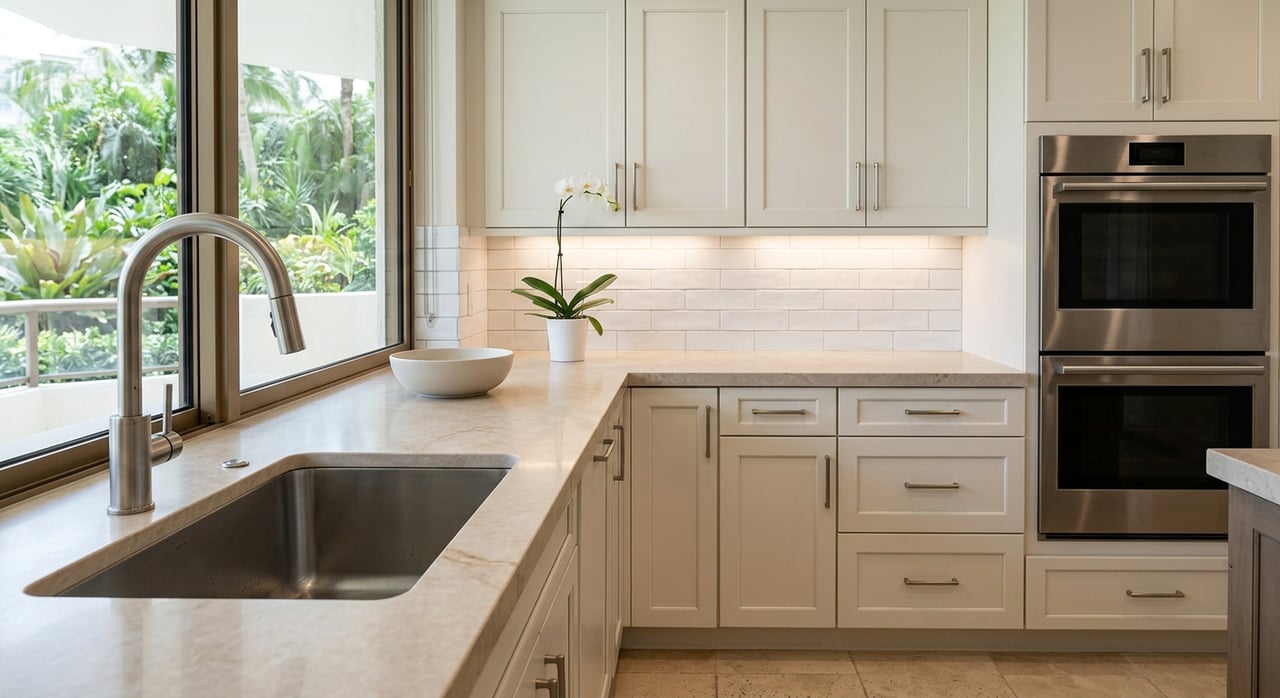
In luxury condos, buyers often react quickly to the spaces they use and judge most heavily. Research points most clearly to kitchens and bathrooms as high-impact areas, especially when they feel current, clean, and easy to live with.
Redfin’s 2024 luxury buyer survey found strong demand for features like double vanities, kitchen islands, granite or quartz countertops, and walk-in pantries. The same survey also found that outdated kitchens and outdated bathrooms were among the biggest buyer turnoffs. If your condo shows its age most clearly in those rooms, a modest refresh may deserve serious consideration.
In Park Shore, beauty is only part of the story. Buyers also pay attention to how a property performs in a coastal environment, especially when it comes to openings and weather protection.
Zillow’s 2024 buyer survey found that 72% of buyers said water-tight windows, doors, and roofs were very or extremely important. Another 61% said the same about wind-resistant doors and windows. In a condo setting, that often means buyers will notice the condition and credibility of windows, sliders, lanais, terraces, and balconies just as much as they notice cabinet finishes.
The smartest pre-sale work is usually targeted. Broad remodeling can be expensive, time-consuming, and difficult to fully recover at resale, especially if the project becomes larger than planned.
According to the 2025 Remodeling Impact Report, estimated resale cost recovery is about 74% for new vinyl windows, 71% for new wood windows, 60% for a minor kitchen upgrade, 60% for a complete kitchen renovation, and 50% for a bathroom renovation. Those numbers support a practical approach: improve what buyers care about most, but avoid overbuilding for the sale.
A refresh is often the strongest strategy when your condo has good bones but feels dated in obvious ways. That can include worn cabinetry finishes, tired hardware, poor lighting, older vanities, or a kitchen that looks functional but behind the market.
In many cases, you do not need to rebuild everything to improve perception. If the layout works and the condition is solid, smaller upgrades can make the home feel more current without creating a months-long construction timeline.
If you are weighing selective pre-sale work, focus on updates with clear buyer appeal and manageable scope:
These types of projects align most closely with what luxury buyers tend to reward and reject first.
Sometimes the better strategy is to skip renovation and bring the condo to market with pricing, presentation, and disclosure handled well. That is especially true when your major features are already competitive, or when construction timing creates more risk than reward.
If your kitchen and baths are in acceptable condition, your windows and doors already inspire confidence, and your outdoor living areas show well, you may gain more by preparing the condo beautifully than by starting a major remodel. In that scenario, preserving time and capital can outweigh the upside of additional construction.
If you are not renovating, staging and presentation become even more important. Buyers still need to feel the space, understand the layout, and imagine how the condo lives day to day.
NAR reports that 83% of buyers’ agents believe staging makes it easier for buyers to visualize a home as a future residence. The rooms most commonly staged are the living room, primary bedroom, and kitchen. For a Park Shore condo, that means clean lines, strong lighting, and a polished indoor-outdoor feel can help offset the absence of a full renovation.
Selling a condo in Florida now involves more than finishes and photography. Building-level studies, disclosures, and association documents can affect buyer confidence and shape how much value an interior renovation really adds.
Florida law requires certain condominium buildings three stories or higher to complete a Structural Integrity Reserve Study at least every 10 years. Associations must distribute the completed study to unit owners within 45 days, and prospective buyers are entitled to copies of key association documents during the sale process. Certain condo sales also require specific contract disclosures when milestone inspection or reserve-study obligations apply.
This matters because buyers may weigh association reserves, inspections, and assessments alongside your interior condition. In some cases, those building-level questions can compete with, or even outweigh, cosmetic improvements in the unit itself.
If your building has active reserve, inspection, or assessment concerns, a costly remodel may not move the needle as much as you hope. A better strategy may be to focus on accurate pricing, thoughtful disclosure preparation, and a polished launch that helps buyers understand the full picture.
Even strong renovation ideas need to be tested against the calendar. In Naples, permit rules and condo-specific approvals can affect whether a project is realistic before your listing goes live.
The City of Naples states that many construction changes require permits. In condominiums, kitchen cabinetry replacement and bathroom vanity replacement require permits, while simple countertop and sink replacement in the same location may not. For window and door replacement, permit applications may require product approvals, design pressures, and, in taller buildings, signed and sealed engineering or architectural calculations.
Before starting any pre-sale work, ask these questions:
If the answer to several of these questions is unclear, the project may be too ambitious for a pre-sale timeline.
If you are trying to decide quickly, use a four-part filter. Compare the likely resale lift, the timeline, the permit burden, and the condo-document risk before committing to work.
Here is a practical way to think about it:
| Scenario | Better Strategy |
|---|---|
| Kitchen and baths look dated, but layout is good | Targeted refresh |
| Windows or doors raise buyer concern | Address openings if timing allows |
| Unit shows well and core features are current | List now with strong presentation |
| Building disclosures or assessments may dominate buyer questions | Focus on pricing and documentation |
| Renovation timeline is uncertain | Avoid major pre-sale construction |
For most Park Shore condo owners, the most defensible spending tends to fall into a short list of priorities. These are the areas buyers are most likely to notice, reward, or question.
If those fundamentals are already strong, listing now may be the more efficient move.
Every Park Shore condo has its own mix of strengths, constraints, and timing considerations. A high-floor residence with strong views and updated openings may need little more than presentation polish. Another unit may benefit from a focused kitchen refresh or bath update before it reaches the market.
The key is to make the decision in context, not in isolation. In a market where buyers can compare options carefully, the right plan is the one that improves confidence without creating unnecessary delay, expense, or disclosure complications.
If you are weighing whether to renovate or list now, a condo-specific strategy can help you protect both time and value. For tailored guidance on Park Shore positioning, preparation, and launch timing, connect with The Norgart Team.
Stay up to date on the latest real estate trends.