Port Royal's Clubhouse Was Supposed to Reopen This Summer. Here's Where the Neighborhood Went Instead.
August 27, 2026
August 27, 2026
What do you call the season when a deadline quietly expires and nobody sends a memo?
Port Royal has been living through one of those seasons for a while now. The neighborhood's own clubhouse, the one at 2900 Gordon Drive that has anchored its social life since 1959, was supposed to reopen this summer. Summer is nearly gone. No doors have opened. And if you have lived here through the last four years, you already know this isn't the first deadline the project has quietly outrun.
That's the part worth sitting with. Not the construction itself, which anyone driving Gordon Drive can see for themselves, but the fact that a neighborhood built around one building has kept its rhythm without it for going on four years, and nobody had to plan for that. It just happened, a couple of miles up the road, on the water, and in kitchens along Third Street South.
Hurricane Ian hit Naples on September 28, 2022, and the storm surge that followed did enough damage to the Port Royal Club's original one-story clubhouse that repair was never seriously on the table. Members voted for a full rebuild instead, a decision that turned into a roughly $100 million, ground-up reconstruction of the building that has functioned as Port Royal's living room for over six decades.
The club's own planning materials set demolition and construction to begin in the summer of 2024, with a grand opening targeted for summer 2026. That target held publicly for a while. Then, in reporting this spring, the timeline shifted to a fall 2026 opening instead, described as a later window than the one residents had been told to expect.
Here's what that means if you're standing in Port Royal right now, in late August: the original deadline has passed. The revised one hasn't arrived yet either. There's no confirmed date attached to "fall," just a season name, which puts the neighborhood in the odd position of waiting on a promise that has already been adjusted once and could shift again before anyone cuts a ribbon.
The most specific thing anyone outside the membership actually knows about this project didn't come from a brochure. It came from a Naples City Council hearing that ran nearly ten hours on August 21, 2024, when the council took up the club's conditional-use petition for what would become a taller, three-level building than the original.
The hearing wasn't a formality. A neighboring homeowner objected to the design on noise grounds, and the conditions that came out of that meeting are unusually granular for a private club project: the third level's after-dinner lounge balcony will be enclosed on its south-facing side, the second level's sunset bar has to close its sliding doors once the space hits 50 percent occupancy, and if code enforcement confirms three noise violations within any twelve-month period, the club has to come back before council to answer for it. The privacy wall separating the two properties will run 11 feet high for 150 feet, well above the city's standard 6-foot limit, before stepping back down to 6 feet for the remaining 425 feet along the shared line.
None of that shows up in a rendering. It's the kind of detail you only get if you were paying attention to what your own city government was arguing about on your street. The design itself, once built, will carry the West Indies architectural language the club has used since the 1950s, led by the architecture firm Hart Howerton with interiors from Champalimaud and construction by Suffolk Construction.
While all of that has worked its way through hearings and revised timelines, Saturday morning in Port Royal has kept happening exactly where it always did: on Third Street South, where a stretch of pavement closes to traffic from 7:30 to 11:30 for a farmers market that has run continuously for more than 25 years. It's the kind of fixture that doesn't need a rebuild to matter, and it hasn't paused for one.
The rest of the week fills in around it. Third Street South carries a run of restaurants that residents rely on without thinking of it as a substitute for anything, because most of these places were part of the routine long before the clubhouse came down. D'Amico's The Continental handles the steakhouse nights. Campiello and Molto Trattoria cover Italian, one leaning rustic and open-fire, the other more traditional trattoria. Osteria Tulia and its sister spot Bar Tulia sit a few doors apart, one built around rustic Italian cooking, the other more built for a cocktail and a shared plate. The French does casual bistro fare with a street-side patio. Chop's City Grill and Truluck's both handle the steak-and-seafood end of the evening, and Veranda E at The Escalante rounds out the fine-dining option a short walk from the water.
None of this reads like a workaround. It reads like a neighborhood that already had its own gravity before the clubhouse closed, which is worth remembering the next time someone describes the rebuild as the thing holding Port Royal's social calendar together.
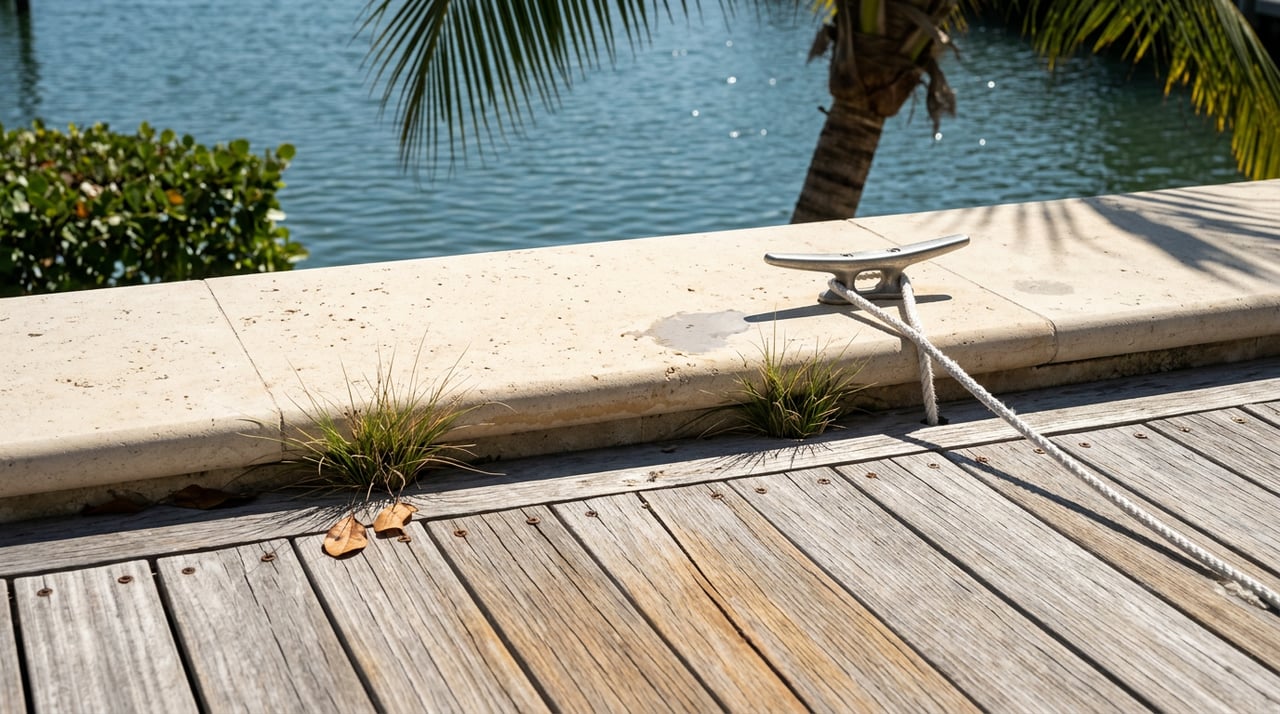
Port Royal was designed around deep-water canals and private docks from the start, and that part of daily life never had a construction fence around it. Boats still leave through Gordon Pass. Docks still fill on weekend mornings. And for residents whose social calendar runs on the water rather than the beach, Naples Yacht Club has been operating the entire time, a few minutes away on Naples Bay.
Founded in 1947 as the city's first private club, Naples Yacht Club has grown from three founding members to more than 600, and it's currently ranked among the top fifty yacht clubs in the world and named the top yacht club in Florida by Platinum Clubs of America. Its calendar runs on the kind of rhythm that doesn't depend on any single neighborhood's amenities: seafood buffets, holiday parties, luncheon cruises, a book club, a full season of dining and social events for a membership that treats boating as the organizing habit of the year rather than a summer hobby.
That's not a replacement for Port Royal's own club. It's simply proof that the water side of this neighborhood's life was never waiting on anything.
When the new clubhouse finally does open, whatever the exact month turns out to be, it will be a different scale of building than the one Hurricane Ian took down. The plans call for roughly 62,000 square feet across two stories, with a porte cochere and open-air breezeway leading members from the entry straight toward Gulf views. Inside, the layout separates a main kitchen from a dedicated pool and beach kitchen, adds two family casual dining rooms alongside a flex dining space, and includes a dedicated banquet room with its own pre-function space for the kind of events the old clubhouse could never quite accommodate. A sunset bar on the upper level and a beach garden below round out the spaces built specifically for the hours before and after dinner.
It's a building designed for a longer, more varied day than the original 1959 structure ever offered. Whether that changes the way Port Royal actually spends its Saturdays, given how firmly established Third Street South and the water routine already are, is the more interesting question, and one nobody will be able to answer until the doors are actually open.
For now, the neighborhood is doing what it has done since 2022: keeping its own calendar, missing deadlines it didn't set for itself, and treating the wait as background noise rather than an event. Summer came and went without a ribbon cutting. Fall is next. Port Royal will notice when it happens, but it isn't holding its breath.
If you're already part of this neighborhood and want a closer read on what's changing here, from the club timeline to the streets around it, The Norgart Team keeps a running eye on Port Royal for exactly these kinds of updates. Become a VIP for private access to what we're tracking next.
Stay up to date on the latest real estate trends.