Why Aqualane Shores' Median Price Fell 34% While the Average Rose 100%
September 17, 2026
September 17, 2026
Pull up two market snapshots for Aqualane Shores from the same few months in 2026 and you get two contradictory headlines. The median sale price for homes that closed in the three months ending June 2026 was $8.6 million, down 33.9 percent from the same period a year earlier. In the same stretch, the average sale price ran the opposite direction, climbing roughly 100 percent year over year to $10.5 million. Same neighborhood. Same window. One number says the market cooled by a third. The other says it doubled.
Neither number is wrong. Both are measuring a market so thin that a single closing can swing the whole read, and a neighborhood so bifurcated that comparing one quarter to the next quarter isn't really comparing like to like. If you're weighing Aqualane Shores against Old Naples or Port Royal using a portal's headline stat, you're not looking at a trend line. You're looking at noise dressed up as a signal.
Aqualane Shores has roughly 350 to 450 single-family homes on its deep-water canals, and in a typical month only a handful of them change hands. Eight homes sold in June 2026, down from 15 in June 2025. That's not a large enough sample for a median or an average to behave the way it would in a market that closes hundreds of transactions a month. One $25 million spec estate closing in a given quarter can pull the average up sharply. Three modest, unrenovated lots closing in the same stretch can pull the median down just as hard. Both things can happen in the same three-month window without either one describing what's actually happening to values.
Days on market tells a related story. Homes that sold in the three months ending June 2026 spent an average of 156 days on the market, down from 217 days the year before. A falling median alongside a faster sale pace isn't the profile of a market in retreat. It reads more like smaller, older parcels moving quickly while the handful of nine-figure new construction listings sit longer, waiting for the right buyer. When you separate the two, the "average sale price up 100 percent" and "median sale price down 34 percent" stop looking like a contradiction and start looking like the same underlying mix shift described two different ways.
Zoom out to a full calendar year and the noise settles. Across all of 2025, roughly 32 single-family homes sold in Aqualane Shores at an average price near $9.8 million. That figure sits almost exactly between the quarterly median and average from mid-2026, which is a good reminder that a full year of sales is a far steadier benchmark than any single quarter, especially in a neighborhood this small.
The reason a three-month window can produce such wild swings is that "Aqualane Shores" currently contains two very different products under one address.
At the lower end, older homes from the 1950s through 1990s, many remodeled and some still original, trade from roughly $1.7 million up toward $8 million. These are the properties most likely to change hands as land plays, where the buyer's real interest is the lot, the water frontage, and the no-bridge canal access rather than the structure sitting on it.
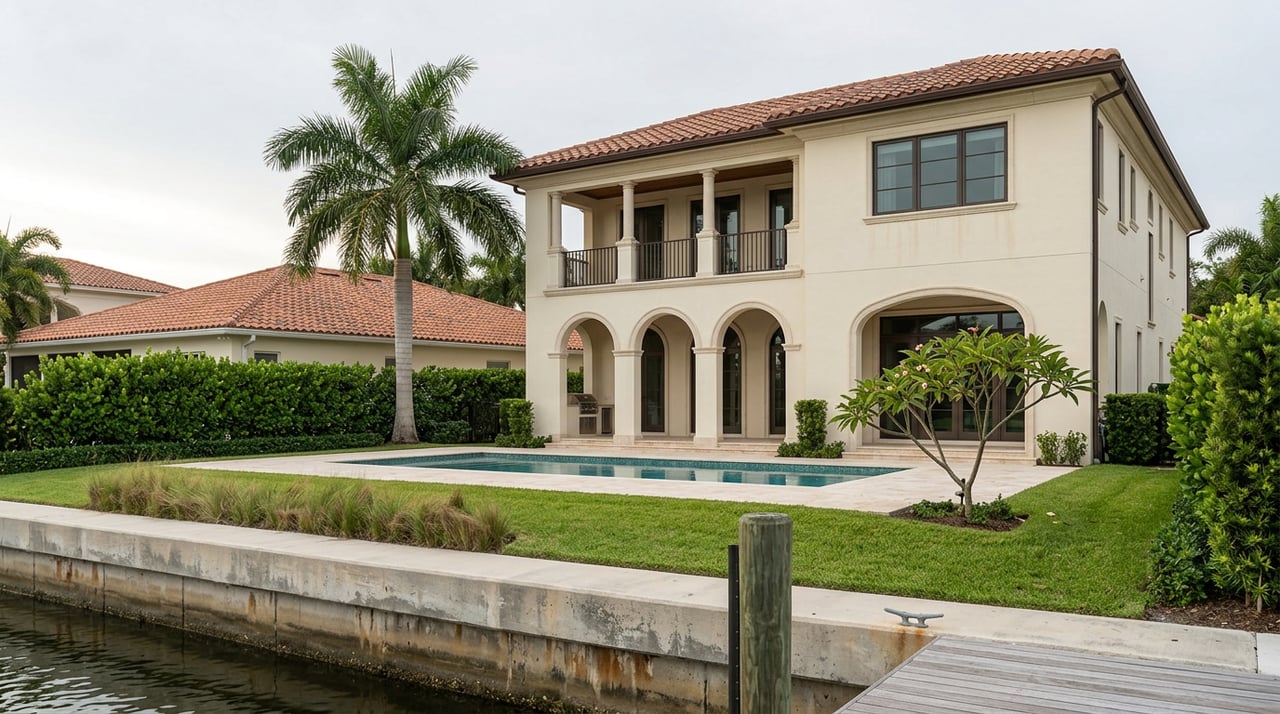
At the upper end, a wave of completed new construction has been asking $20 million and up, with some listings well past $25 million. Several of these homes finished construction in 2025 and early 2026, built by firms including Toscana Homes, D. Garrett Construction, and C&E Builders, with design work from Stofft Cooney Architects, W Design, Amy Storm and Company, and architect Jon Kukk. These are turnkey, resort-finished estates with wine rooms, infinity pools, and rebuilt boathouses, priced to reflect current construction costs on top of the land.
As of early September 2026, active inventory in the neighborhood spanned from roughly $899,000 up to $20 million, with an average asking price near $11.4 million. That spread, nearly 22-fold between the lowest and highest active list price in one small enclave, is the real story the median and average are both trying and failing to summarize in a single figure.
| Segment | Typical price range | What you're buying |
|---|---|---|
| Vintage or remodeled homes | $1.7M to $8M | Land value and canal access, structure condition varies widely, renovation or teardown potential |
| New construction spec estates | $20M to $25M+ | Turnkey 2025-2026 builds with engineered seawalls, boat lifts, and full resort finishes already priced in |
If you're comparing what Aqualane Shores "costs" against Old Naples or Coquina Sands, the honest answer depends entirely on which of these two bands you're actually shopping.
Part of what separates the two price bands isn't just square footage or finish level. It's what's sitting behind the house.
Aqualane Shores' canals fall under the City of Naples' West Naples Bay Special Taxing District, which covers the canal-maintenance and dredging obligations for canal-front parcels roughly between 14th Avenue South and Galleon Drive. Homes that face Naples Bay directly sit outside that district, which means two lots on the same street can carry meaningfully different maintenance and assessment profiles depending on which side of that boundary they fall on.
Flood insurance adds another layer that the median and average both quietly ignore. The National Flood Insurance Program caps standard building coverage at $250,000 for a single-family home, and by design that policy does not extend to seawalls, docks, or piers sitting on or over the water. The City of Naples' own guidance on flood coverage confirms the $250,000 building limit directly, and FEMA's national coverage summary lists seawalls and docks among the property types a standard flood policy simply does not touch. In a neighborhood where the dock and seawall are the entire reason the address commands a premium, that gap matters more here than it would two blocks inland.
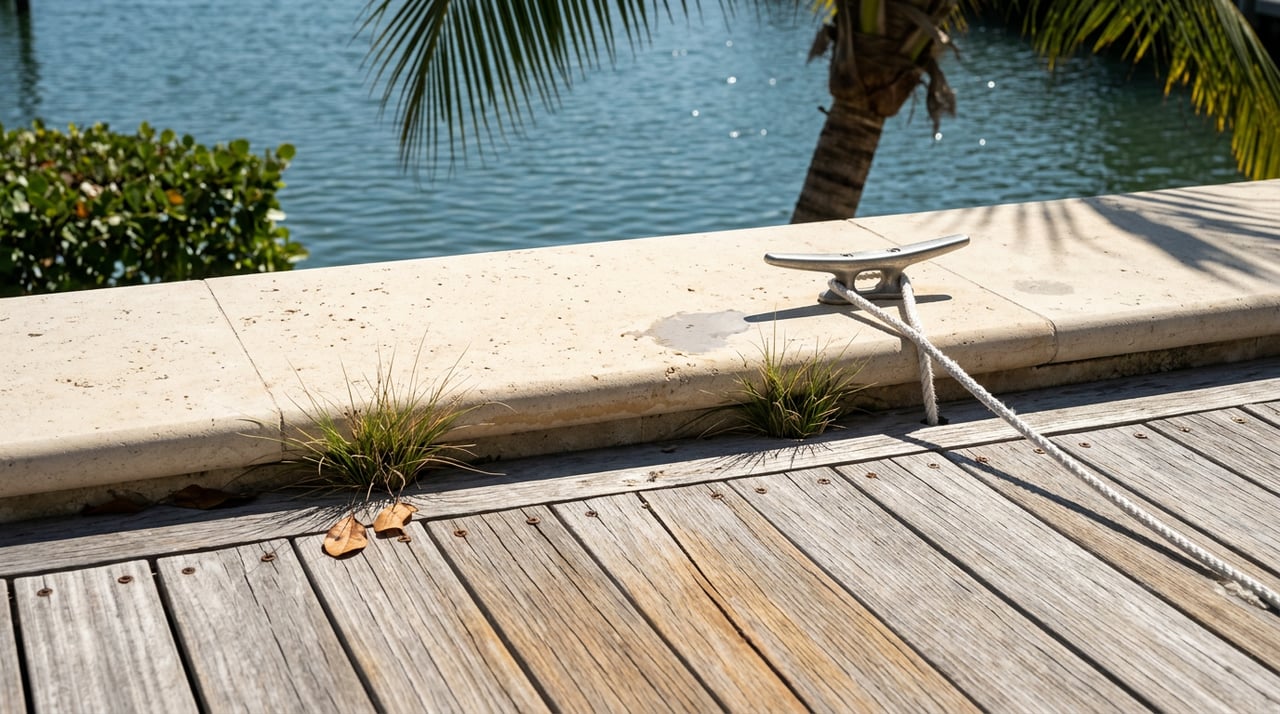
New construction prices typically bake the cost of an engineered seawall and dock into the number on the listing sheet. Older homes often carry that cost as an unpriced future liability, one a buyer discovers only after ordering an inspection or, worse, after a storm. That distinction alone explains a meaningful share of the spread between a $2 million teardown candidate and a $22 million completed estate, and it's a distinction no median or average can capture.
If you're using Aqualane Shores as a data point while comparing Naples neighborhoods, three adjustments will serve you better than trusting whatever the current quarter's median says. Ask which price band a specific listing sits in before comparing it to anything else. Weight a full year of sales more heavily than any single quarter, given how few transactions this neighborhood produces in any three-month stretch. And treat the seawall, dock, and canal-district status as pricing inputs in their own right, not footnotes to check after you've already fallen in love with a listing photo.
None of this makes Aqualane Shores harder to love. It makes the number on the portal page a starting question rather than a finished answer, which is exactly how a neighborhood this small and this specific should be read.
If you're comparing Aqualane Shores against Port Royal, Old Naples, or Gulf Shore Boulevard and want the actual mechanics behind a specific listing rather than a headline stat, The Norgart Team can walk you through which price band, canal designation, and construction vintage you're really looking at before you make an offer.
Is Aqualane Shores' market cooling in 2026? The data doesn't support that conclusion on its own. A falling median sale price for a single quarter, paired with faster days on market and a rising average, is more consistent with a shift in which homes happened to close than with a broad decline in value.
Why did homes sell faster even as the reported median price fell? In a market this thin, a faster median sale pace and a lower median price can both result from more of the smaller, older, lower-priced homes closing in a given window while the larger new-construction listings take longer to find the right buyer.
Does a lower neighborhood median mean a specific waterfront lot is now cheaper? Not necessarily. The median reflects whatever mix of homes happened to sell in that window, not the value of any individual property. A specific lot's price still depends on its canal designation, seawall and dock condition, and which of the two price bands the home actually belongs to.
Stay up to date on the latest real estate trends.

dining
Old Naples News